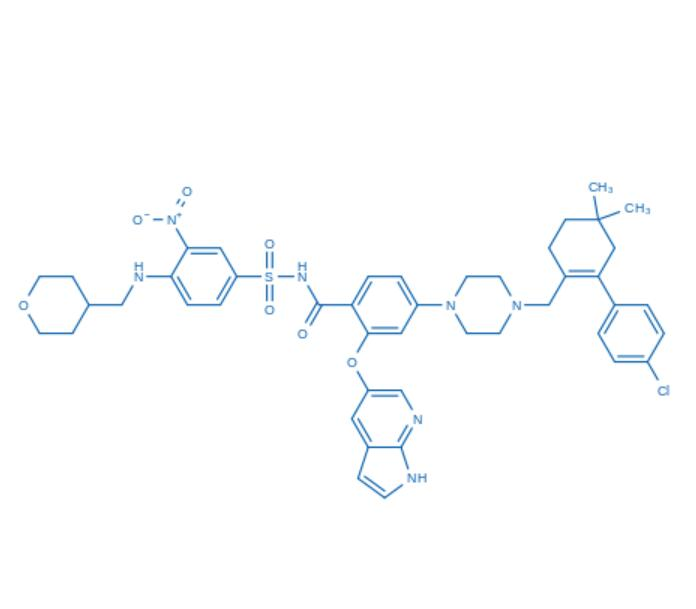
货号:A3680
储存条件:粉末-20°C可保存3年;液体-80°C可保存12月。
产品描述
Bcl-2 (B-cell lymphoma 2) is the first identified apoptotic regulator. It belongs to Bcl-2 family commitment to PCD, which regulates apoptosis, pro-apoptosis or anti-apoptosis. ABT-199 is a highly potent inhibitor of Bcl-2, re-engineered from ABT-263. It has subnanomolar affinity (Ki<0.010 nM, analysis by TR–FRET assay), which is over three orders of magnitude to Bcl-XL (Ki=48nM) and Bcl-W (Ki=245 nM). ABT-199 can disrupt BCL-2–BIM complex and induce multiple hallmarks of apoptosis, including cytochrome c release, caspase activation, the externalization of phosphatidylserine and the accumulation of sub-G0/G1 DNA, with lower concentration than ABT-263. Thus it facilitates ABT-199 to have cell-killing activity to Bcl-2 high-expressed NHL cell lines. ABT-199 can inhibit tumor xenograft growth as a single agent or combination with rituximab and bendamustine.
靶点
Bcl-2
Ki:0.01nM
作用机制
ABT-199 is complicated by the high degree of similarity within the BH3-binding domains of Bcl-2 and Bcl-XL.
储存液制备 | 质量 | 1 mg | 5 mg | 10 mg |
1 mM | 1.1515 mL | 5.7575 mL | 11.5149 mL | |
5 mM | 0.2303 mL | 1.1515 mL | 2.3030 mL | |
10 mM | 0.1151 mL | 0.5757 mL | 1.1515 mL |
产品性质
CAS号 | 1257044-40-8 | |
分子式 | C257H383N65O77S6 | |
分子量 | 868.44 | |
溶解度 | DMSO | 95.0 mg/mL (109.4 mM) warming |
Water | lnsoluble | |
Ethanol | lnsoluble | |